The Santissima of Gussago: an icon between history and rebirth
Franciacortino passa da qui!
Summary
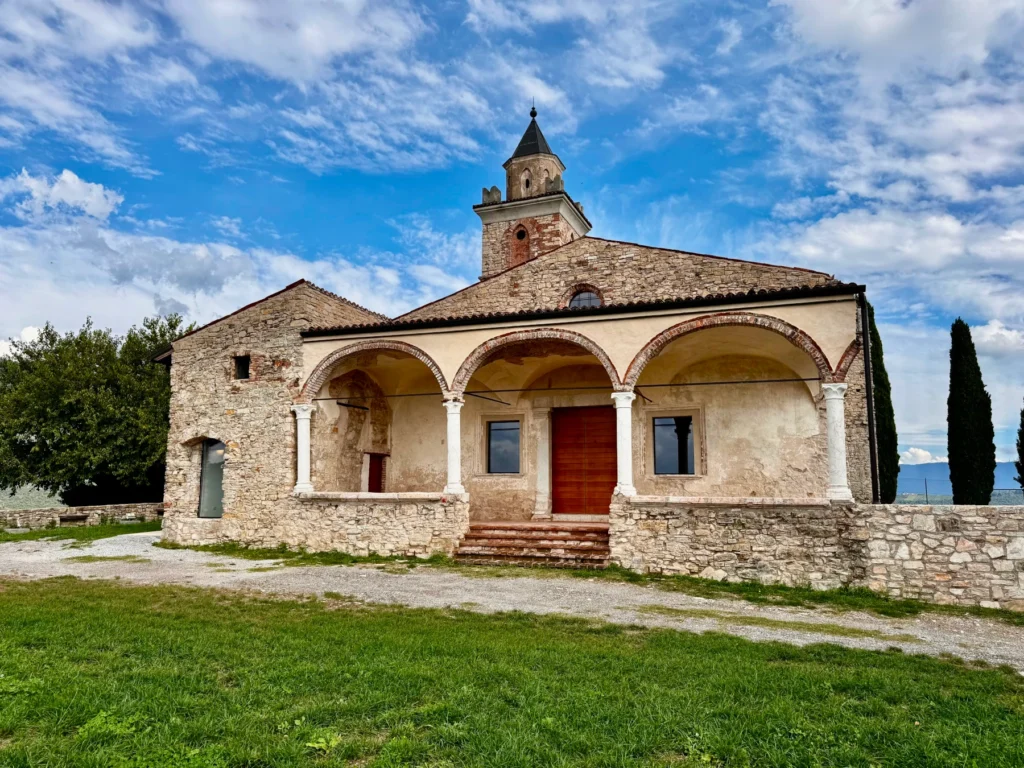
Today, the Grande Giro catches sight of one of Franciacorta’s most iconic symbols: the Santissima of Gussago. From the heights of Barbisone Hill, this complex elegantly dominates the town and the surrounding landscape. Its charm is the result of a centuries-old history that saw it transform from a community church into a Dominican convent, and finally into a noble residence.
I had the pleasure of discovering this place accompanied first by Linda Peli and later by a member of the Gruppo Sentieri Gussago (Civil Protection Volunteers), the association that cares for it with great dedication. While the Franciacortino route does not pass directly by its walls, the Santissima reveals itself as early as Castegnato, allowing for a closer view as you enter Gussago via Giulio Togni and continue onto via Sale. Today’s segment will then push towards Cellatica, reaching the locality of Fantasina.
The card:
From the church of Santa Maria alla “Fantasina”.
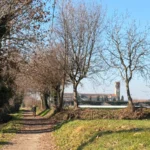
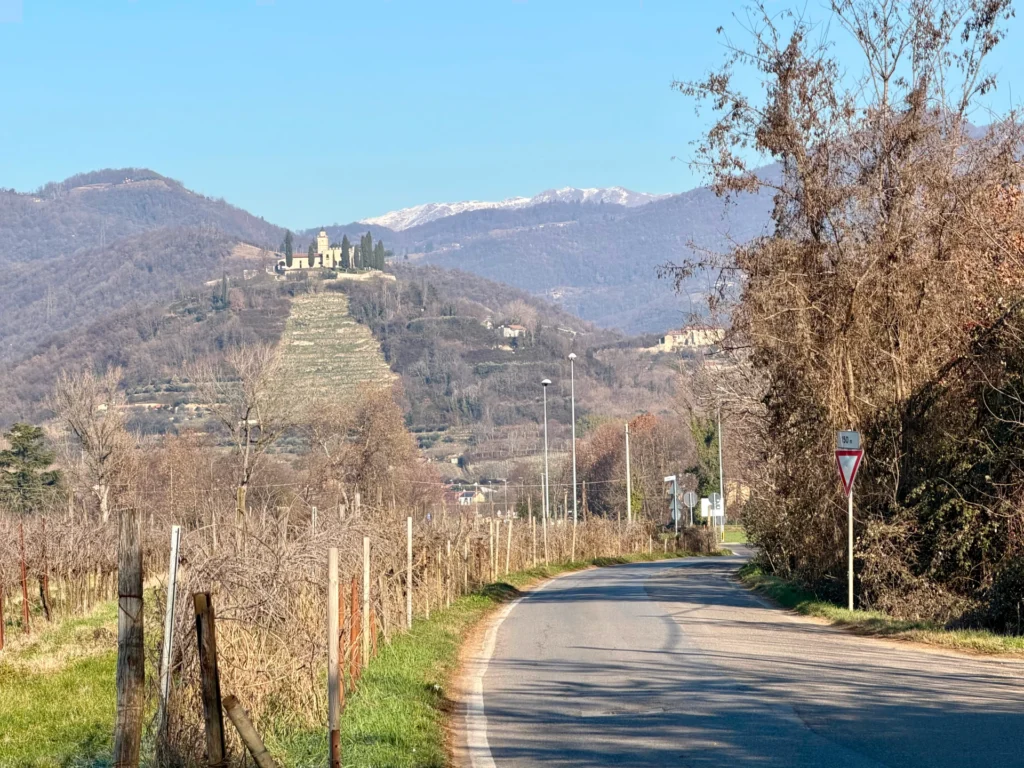
Leaving the Castegnato area, you enter Via Cavezzo and Via Togni: two secondary roads immersed in the countryside that lead towards Gussago. It is precisely at the end of Via Togni, just before turning onto Via Sale, that the landscape changes: your gaze is captivated by the majesty of Colle Delma (an offshoot of Mount Barbisone) rising to the left. From this privileged position, you can admire the unmistakable profile of the Santissima, whose crenellated silhouette dominates the entire Gussago skyline.
From Via Sale, the route becomes more winding as it approaches the border with Cellatica. The route passes through the historic village of the same name, which can be reached by passing the ancient charm of Palazzo Caprioli, before turning immediately right onto Via Santo Stefano Martire.
The route continues beyond the cemetery hill, entering the town with a series of quick passages: turn left onto Via Trieste, right onto Via Genova, left again onto Via Donatori di Sangue and finally right onto Via Pianette.
Continuing straight, you'll join the Vicinale Torrente Canale road, which here coincides with the scenic Ciclovia delle Sorelle (Brescia-Bergamo) cycle path. At the end of the cycle path, a final right turn onto Via Dott. G. Zappa and a quick left turn onto Via dei Prati lead to the hamlet of Fantasina. This is where today's stage ends; we'll resume our journey from here in the next chapter of our journey.
Tap the map to activate it
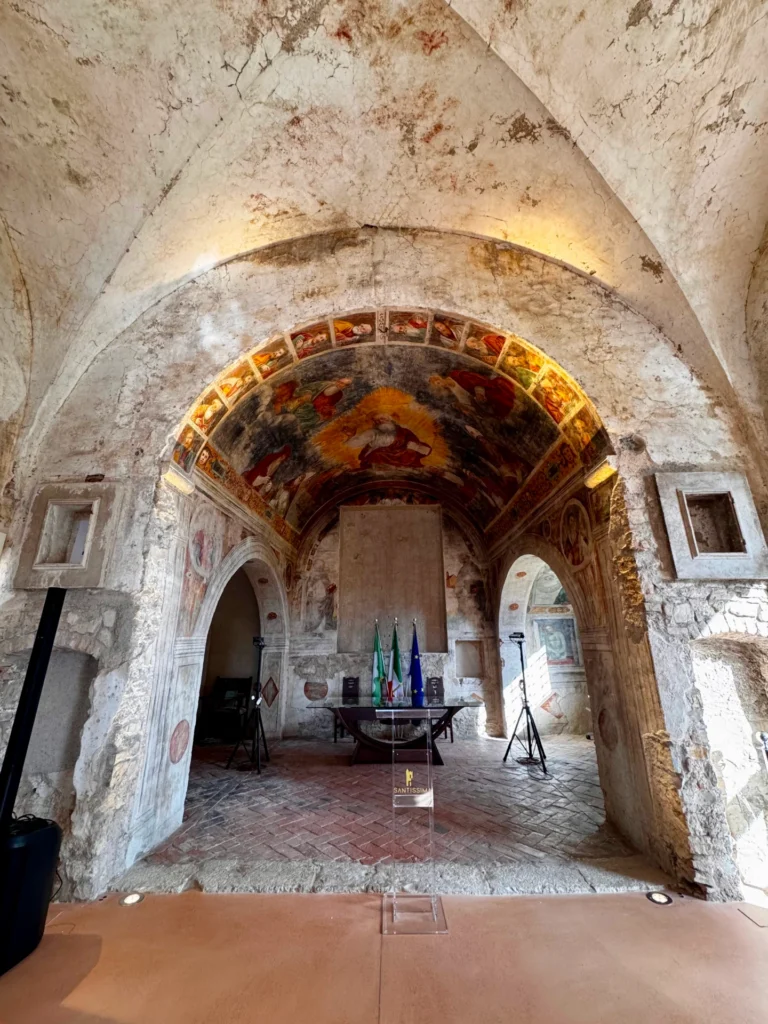
La Santissima – origini e rinascita nel segno della comunità.
An unmistakable symbol of Gussago, the Santissima boasts centuries of history: originally built as a community church, it became a Dominican convent in the 15th century, before being transformed into the elegant noble residence of Paolo Richiedei in the 1800s. It was within these very walls that the painter Angelo Inganni found his inspiration. Following a period of decline after World War II, its rebirth began in 2010 when it was reacquired by the Municipality of Gussago, sparking a meticulous restoration fueled by the passion of local volunteers. The true uniqueness of the Santissima lies in its genesis as a civic church—a sacred building born from the will and patronage of the community itself. This concept is closely linked to the "right of patronage" (juspatronatus), a medieval legal institution of fundamental importance for many local churches. Under this right, the community (or a noble family) held the privilege of appointing priests and managing the property in exchange for maintaining the structure. This bond was civil before it was religious, historically documented as early as January 11, 1460, when an indulgence from Pope Pius II described the building as a small church under the patronage of the local community. The restoration of the Santissima followed a dual path—both structural and emotional—bolstered by its success in the FAI "Luoghi del Cuore" (Places of the Heart) national campaign. A symbol of this revival is the cycle of frescoes in the presbytery: these works, attributed to Paolo Caylina the Younger, represent the excellence of the Brescian Renaissance and were fully recovered during the structural consolidation. Today, thanks to the synergy between the Municipality of Gussago and local associations, the Santissima has been established as a vibrant cultural hub. It is no longer merely a monument to be observed with respect from afar, but a living place experiencing a true "second youth," masterfully blending historical preservation with daily community life.
This rebirth translates into concrete initiatives that turn the complex into a terrace overlooking Franciacorta, where art meets the power of volunteerism.
- Starting from February 2026, the complex will be accessible again thanks to a schedule of regular openings on the first Sunday of every month (excluding August). Managed by the newly formed association 'Santissima nel Cuore', these days will feature free admission with no reservation required, guided tours, and a small refreshment point for visitors.
- New Restorations (FAI Funding): Just this month (January 2026), a significant allocation of 35,000 euros was confirmed by FAI - I Luoghi del Cuore. These funds will be dedicated to completing the restoration of the interior decorative elements and the delicate consolidation of the tower, which was damaged by a lightning strike in the past.
- Promoting the Territory: The perimeter of the Santissima and its surrounding park are now fully accessible and dedicatedly maintained by local volunteers. This serves as the ultimate confirmation of the profound bond between the community and the monument, making this site a truly unique gem in the Franciacorta landscape.
Founder of Franciacortino
I explore Franciacorta by bike, pedaling slowly through stories, roads, and details.